MIST
Magnetosphere, Ionosphere and Solar-Terrestrial
Latest articles
- Introducing XIM to Study the Spectral Properties of Solar Wind Charge Exchange at Earth’s Magnetospheric Boundaries
- Saturn's Auroral Dusk Sector Magnetosphere-Ionosphere Coupling During Cassini's Proximal Orbits
- A Multi-Event Comparison of dB/dt Resulting From Omega Band Aurora
- Can we Resolve Magnetosheath Jets with a Soft X-ray Imager?
- Russell-McPherron mechanism effect on space junk de-orbiting
Latest news
2026 MIST Council Election Results
It is our pleasure to announce the results of the latest MIST Council Election.
- Samuel Wharton (University of Leicester) is elected for a 3 year term as a MIST Councillor
- Jewel Abbey Relampagos (Lancaster University) is elected for a 1 year term as the MIST Student Representative
In addition, due to concerns from the community regarding the ongoing UKRI/STFC funding situation, MIST Council have also decided to charter Mark Lester (University of Leicester) as an additional councillor to inform and steer the council in matters related to this specific brief, as set out in Article 4.5 of the MIST Charter.
We would like to congratulate everyone on their new roles. The full composition of Council can be found on the MIST website (https://www.mist.ac.uk/community/mist-council). We would like to thank all the candidates for putting themselves forward and everyone who took part in the voting. We received votes from 132 people which represents a turnout of 21.5% of people registered to receive the MIST emailing list.
Finally, MIST Council would like to extend their thanks and gratitude to our outgoing members: Fiona Ball and Georgios Nicolaou. We would also like to say a special thank you to Andy Smith who was co-opted to be on MIST council while Rosie Johnson was on maternity leave, thank you for all of your hard work.
Open Letter Ready For Signatories
Protect MIST Science! Sign the MIST Community Open Letter on the STFC funding cuts!
https://sites.google.com/view/uk-mist-community-open-letter
Statement from MIST Council regarding the STFC Funding Situation
Statement from MIST Council regarding the STFC Funding Situation
MIST Council is deeply concerned by the ongoing STFC funding uncertainty and its impact on our community and beyond.
The current combination of prospective delayed and reduced funding, together with already volatile financial situations at universities across the UK, is placing significant strain on research groups. In some cases, institutions may be unable to support researchers through gaps between projects, increasing precarity across the community and adding significant pressure on early-career researchers.
We are concerned that continued uncertainty risks accelerating a brain drain from the UK, as skilled researchers reconsider their future in a system offering limited stability. The loss of expertise at any career stage would have lasting consequences for UK space science.
What is going on?
For those that are unaware of the situation, it is complex and evolving. We suggest the following sources to get up to speed on the current developments.
https://ras.ac.uk/news-and-press/news/proposed-budget-cuts-catastrophe-uk-astronomy
What are we doing about it?
Behind the scenes, MIST Council is actively engaging with relevant parties to understand the scale of the challenge and to identify constructive ways forward.
- We are seeking seasoned members of the community to join MIST Council on a task force to help develop options and represent the needs of our community. If you would like to be involved, please reach out to us via the MIST Council email (This email address is being protected from spambots. You need JavaScript enabled to view it.) by the end of this week (13th February 2026).
- In addition to the task force, we want to provide an open forum for discussion and collective input among all members of the wider MIST community. We are exploring options and will be in touch as soon as possible with further details.
- We believe in working together in the face of the current challenges and we are collaborating with UKSP and others to strive for a fair and positive outcome for all. We are reaching out to members of the SSAP (Solar System Advisory Panel) to explore the hosting of a community town hall meeting, like the one already being organised by the AAP (Astronomy Advisory Panel), to provide an open forum for discussion and collective input.
What can you do to help?
There are several open letters representing people in various career stages that have been made available to sign. We encourage you to read the relevant letter(s) and to sign them if you support them:
- Fellowship Holders: https://advancedfellows-openletter-stfc.github.io/index.html
- Early Career Researchers: https://ecr-openletter-stfc.github.io/
The Royal Astronomical Society are also urging Fellows to lobby their MPs against the cuts, and have included a template letter that can be used to do so:
https://ras.ac.uk/news-and-press/news/ras-fellows-urged-lobby-against-unprecedented-cuts
MIST Council will continue to advocate for transparency, stability, and funding structures that recognise both the long-term nature of our science and the people who deliver it.
We thank you for your continued support in this period of uncertainty.
Please contact This email address is being protected from spambots. You need JavaScript enabled to view it. if you have further suggestions.
MIST Council

Announcement of New MIST Council 2025
We are very pleased to announce the following members of the community have been elected to MIST Council:
- Gemma Bower (University of Leicester), MIST Councillor
- Tom Elsden (University of St Andrews), MIST Councillor
- Cameron Patterson (Lancaster University), MIST Councillor
- Fiona Ball (University of Southampton), Student Representative
They will begin their terms in July 2025.
We thank outgoing MIST Council members: Maria Walach, Chiara Lazzeri and Emma Woodfield. Andy Smith will remain on council a little longer as a co-opted member to cover Rosie Johnson's maternity leave.
The current composition of Council can be found on our website (https://www.mist.ac.uk/community/mist-council).
Announcement of New MIST Councillors.
We are very pleased to announce the following members of the community have been elected unopposed to MIST Council:
- Rosie Johnson (Aberystwyth University), MIST Councillor
- Matthew Brown (University of Birmingham), MIST Councillor
- Chiara Lazzeri (MSSL, UCL), Student Representative
Rosie, Matthew, and Chiara will begin their terms in July. This will coincide with Jasmine Kaur Sandhu, Beatriz Sanchez-Cano, and Sophie Maguire outgoing as Councillors.
The current composition of Council can be found on our website, and this will be amended in July to reflect this announcement (https://www.mist.ac.uk/community/mist-council).
Nuggets of MIST science, summarising recent papers from the UK MIST community in a bitesize format.
If you would like to submit a nugget, please fill in the following form: https://forms.gle/DGNZiP7sA3e8U29ZA and we will arrange a slot for you in the schedule. Nuggets should be 100–300 words long and include a figure/animation. Please get in touch!
If you have any issues with the form, please contact This email address is being protected from spambots. You need JavaScript enabled to view it..
Global Morphology of Chorus Waves in the Outer Radiation Belt and the Effect of Geomagnetic Activity and fpe/fce
Global Morphology of Chorus Waves in the Outer Radiation Belt and the Effect of Geomagnetic Activity and fpe/fce
By Kaine Bunting (British Antarctic Survey)
Chorus waves are naturally occurring plasma waves often observed in the Earth’s outer radiation belt that strongly influence the behaviour of energetic electrons. These waves can both accelerate electrons to relativistic energies, which poses a threat to satellites, as well as scatter electrons into Earth's atmosphere, where they are consequently lost.
The ratio between the electron plasma frequency (fpe) and electron gyrofrequency (fce) holds information on both electron density and magnetic field strength and significantly influences the efficiency of these processes, with electron acceleration being most effective during periods of low fpe/fce.
Bunting et al. (2026) analyses a combined 24.5 years of wave data from three THEMIS satellites to investigate the effect of fpe/fce, geomagnetic activity and normalized frequency on the spatial distribution and intensity of chorus waves.
The strongest waves are generally observed on the dawn-side of the Earth during active geomagnetic conditions. Figure 1 shows global plots of the equatorial (|MLAT| < 9°) chorus wave intensity during active conditions (AE > 200nT). At intermediate relative frequencies (0.3fce < f < 0.4fce), chorus is largely independent of fpe/fce. However, at low frequencies (flhr < f < 0.1fce), strong waves are most often associated with high fpe/fce (>10) and at high frequencies (0.5fce < f < 0.7fce), chorus is strongest at low fpe/fce (<6).
Overall, this study highlights the critical role of fpe/fce on the spatial distribution and dynamic behaviour of chorus waves under varying geomagnetic conditions, as well as its influence on wave-particle interactions. During a geomagnetic storm fpe/fce outside of the plasmapause may gradually change from low to high values over the course of the recovery phase, suggesting that the role of chorus may change from efficient acceleration early in the recovery phase to little or no acceleration and even loss toward the end of the recovery phase.
See publication for details:
Bunting, K. A., Meredith, N. P., Bortnik, J., Ma, Q., Matsuura, R., & Shen, X.-C. (2026). Global morphology of chorus waves in the outer radiation belt and the effect of geomagnetic activity and fpe/fce. Journal of Geophysical Research: Space Physics, 131, e2025JA034737. https://doi.org/10.1029/2025JA034737
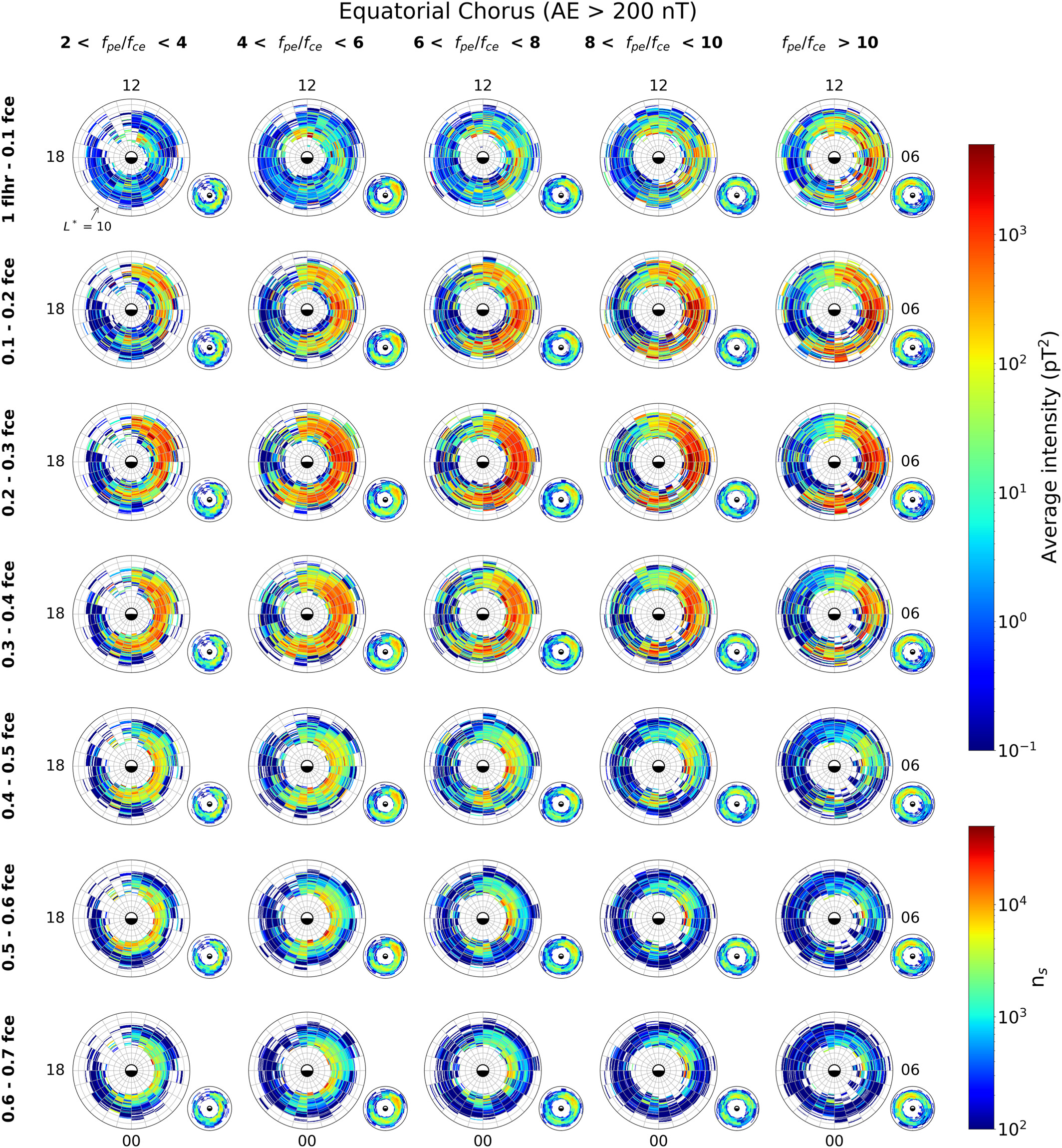
Figure 1 - Global maps of the average chorus wave intensity during active geomagnetic conditions (AE > 200nT) in the equatorial region (MLAT < 9°) as a function of L* and magnetic local time for, from top to bottom, increasing relative frequency, and, from left to right, increasing fpe/fce. The maps extend linearly out to L* = 10 with noon at the top and dawn to the right. The average intensities are shown in the large panels and the corresponding sampling distributions in the small panels to the bottom right of each large panel.
Energetic Proton Dropouts During the Juno Flyby of Europa Strongly Depend on Magnetic Field Perturbations
Energetic Proton Dropouts During the Juno Flyby of Europa Strongly Depend on Magnetic Field Perturbations
By Hans Huybrighs (DIAS)
In September 2022 NASA's Juno spacecraft flew by Jupiter's ocean moon Europa. In this study we analyzed energetic ion dropouts measured near Europa. We care about energetic ions because they bombard Europa's icy surface . While they make the surface inhospitable, they might also help produce oxidants from the ice that could form a source of energy for life in the ocean.
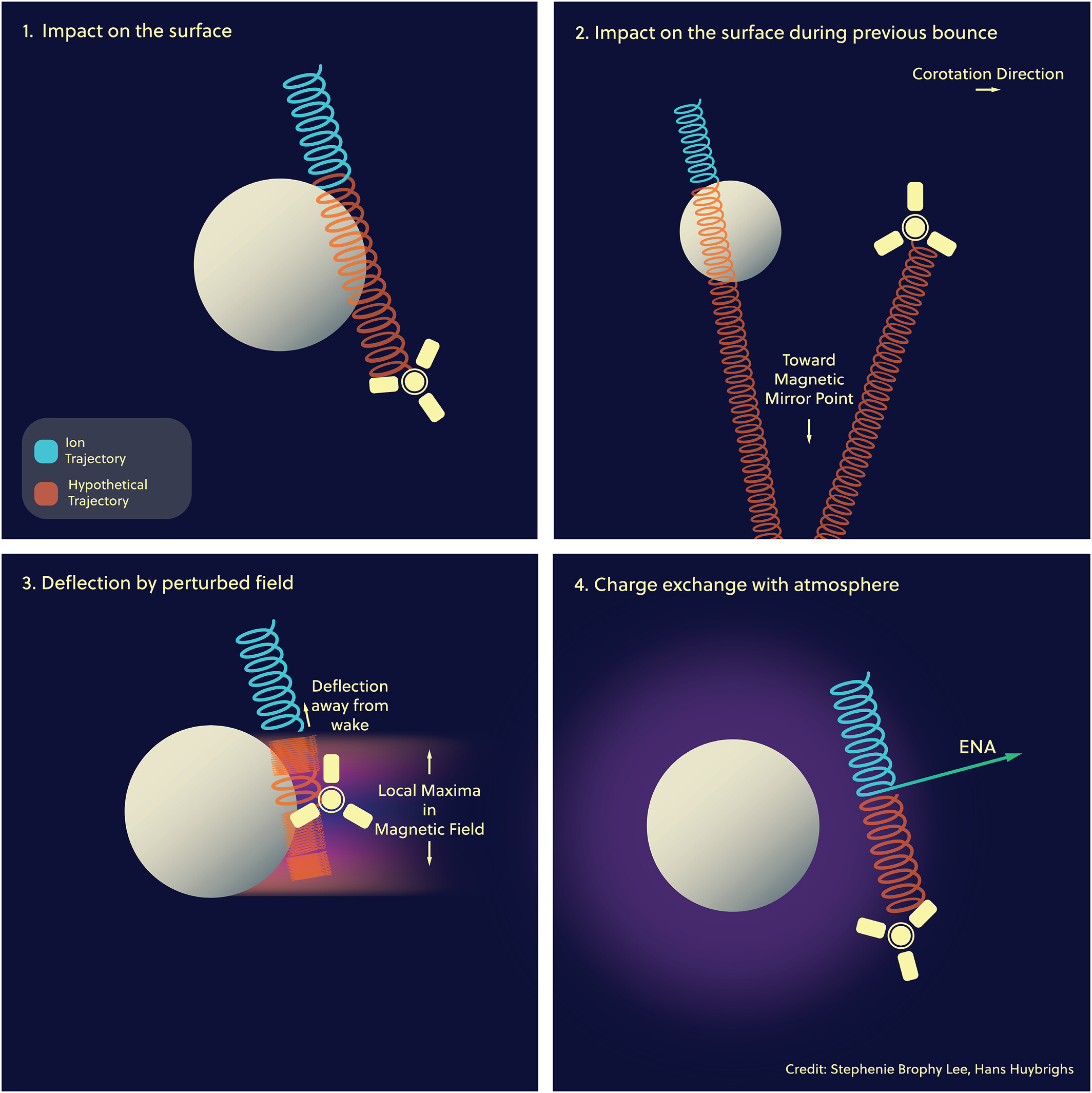
The Juno measurements show what happens with the energetic protons at 350 km above the surface, in Europa’s wake (considering the general sense of motion of the protons). There, protons have disappeared, compared to further away where they are abundant. The cartoon below shows some classical ideas about what happens to the protons near Europa (panel 1-2).
Using particle tracing simulations of the ions we can show that the deflections by magnetic fields (3) are also important. In fact, at 100 keV magnetic deflections are the dominant factor that determine the ion abundance. At 1 MeV its a combination of magnetic deflections and the effect shown in panel 2. The simulations also show that the shape of the proton dropout region depends on the exact configuration of the magnetic field, which can vary depending on the atmosphere and electron beams in the wake. All this helps us better understand what happens with the energetic ions and shows us that our ideas of Europa's atmosphere and magnetic fields are reasonable but that improvements can be made.
See publication for details:
, , , , , , et al. (2025). Energetic proton dropouts during the Juno flyby of Europa strongly depend on magnetic field perturbations. Journal of Geophysical Research: Space Physics, 130, e2025JA034000. https://doi.org/10.1029/2025JA034000
Estimating Soft X-Ray Emission from Uranus's Magnetosheath
Estimating Soft X-Ray Emission from Uranus's Magnetosheath
By Dan Naylor (Lancaster University)
Soft X-rays can be generated within planetary magnetosheaths due to charge exchange between neutrals and highly charged solar wind ions such as O7+. Imaging of the soft X-rays is an emerging technology that aims to provide global and dynamic views of the magnetosheath and cusps, and their response to solar wind driving. The ESA-CAS SMILE mission will soon be launched with a soft X-ray imager (SXI) instrument onboard to investigate the terrestrial magnetosheath. We explore the viability of similar investigations at Uranus.
Uranus has one of the most unusual and complex environments in the solar system. A large obliquity combined with a highly tilted, offset magnetic axis result in an asymmetric and constantly varying magnetosphere where the plasma and neutral source rates from the moons are unconstrained. We impose a simple bullet shaped magnetopause and moon tori informed by Voyager 2 observations to predict soft X-ray emission from the Uranian magnetosheath. We estimate volumetric emission rates of soft X-rays are on the order of 10-10 photon cm-3 s-1, being higher at equinox due to the orientation of the magnetosheath relative to the moon tori. Simple estimates of intensity and flux find that a SMILE-like instrument could detect ~100 photons in a quarter of a planetary rotation at a distance of 212 RU, as shown in the figure. A hypothetical future imager, with improved FOV and effective area, would detect ~20,000 photons per planetary rotation at 100 RU. These are promising initial results that suggest imaging of the magnetosheath is possible within key system timescales. Future studies will include magnetospheric cusps and a full range of solar wind ions, which are anticipated to increase emission rates.
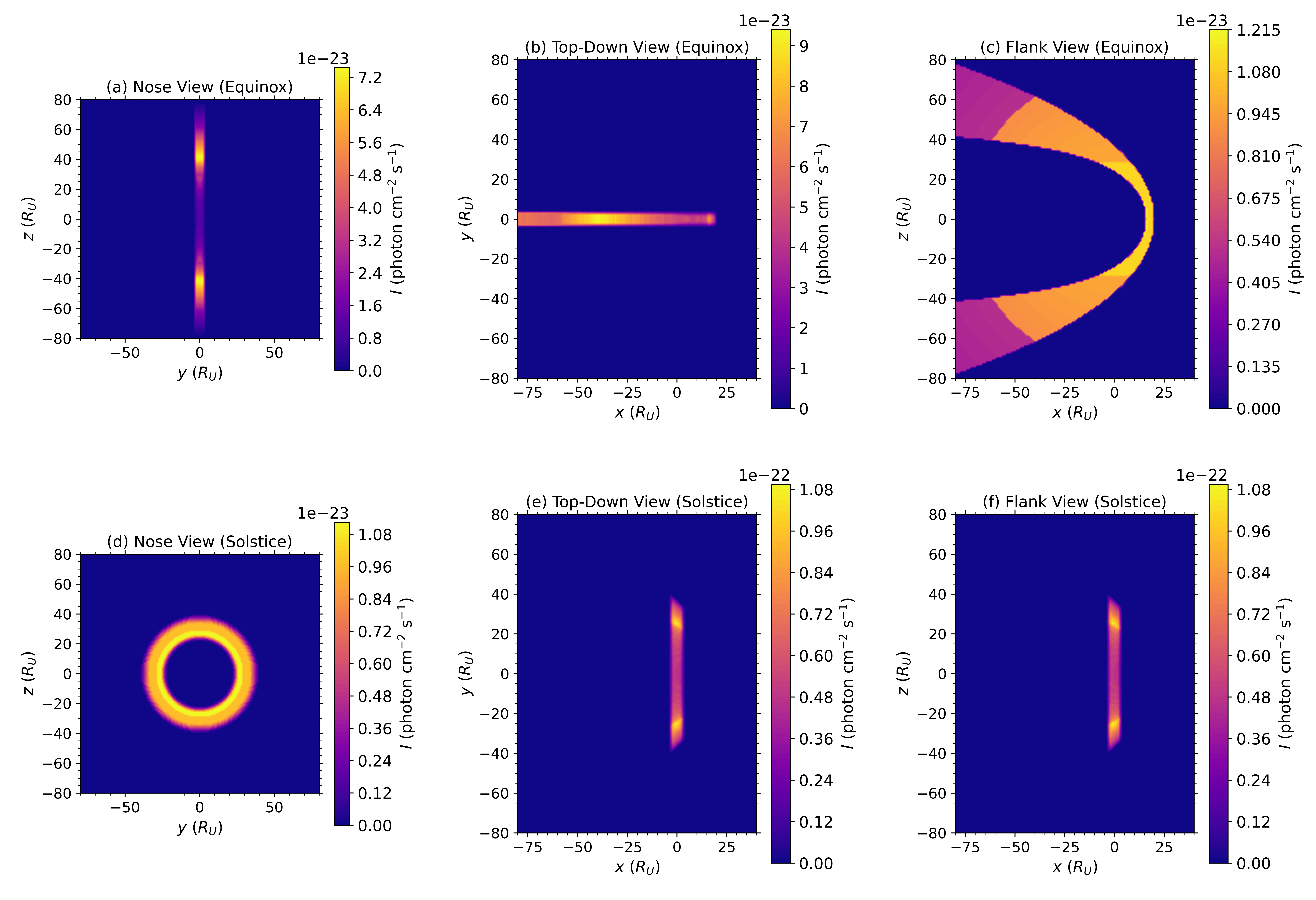
Modelled intensity maps for a SMILE‐like SXI at 212 RU from different viewing geometries at (top row) equinox, where the neutrals are edge-on to the Sun, and (bottom row) solstice, where the neutrals are ring on to the Sun: (a/d) front‐on, (b/e) top‐down and (c/f) side‐on. The different panels show that the amount of flux detected is dependent on viewing position, and an orbital mission should consider the implications of different possible imaging positions.
See publication for details:
Naylor, D., Ray, L. C., Dunn, W. R., Jasinski, J. M., & Paty, C. (2025). Estimating soft X-ray emission from Uranus's magnetosheath. Journal of Geophysical Research: Space Physics, 130, e2025JA034171. https://doi.org/10.1029/2025JA034171
Omega Bands as a Source of Large dB/dt in the Dawn Sector
Omega Bands as a Source of Large dB/dt in the Dawn Sector
By Rosie Hodnett (University of Leicester)
Omega bands are a type of aurora which occur in the dawn sector and drift eastwards. They are often described as having a morphology similar to that of the Greek letter Ω. Omega bands have been shown to have the potential to cause geomagnetically induced currents, which are an important area of research as they are recognised as a hazard to our infrastructure, such as power grids.
In this study, we have examined an omega band event which occurred from 23 – 04 UT on 2012-11-13—14 using multiple instruments around Tromsø, Norway (69.6°N, 19.2°E). The first two panels (a-b) of the figure show EISCAT UHF/VHF electron density measurements, panel (c) shows a keogram of all-sky camera (ASC) data. It is clear that when the luminous aurora passes over head, enhancements in electron density are observed.
Panel (d) shows the magnetic field perturbations as measured by the IMAGE magnetometer and (e) shows dB/dt. For this event, we saw large perturbations in the Y component of the magnetic field, with a maximum peak of approx. 915 nT. The rapid motion of the omega bands leads to large dB/dt of above 10 nT/s.
Panel (f) shows AMPERE data, where the yellow dashed line is the location of EISCAT, where red is upward field aligned current (FAC) and blue is downward FAC. The auroral signatures and large dB/dt are evident when EISCAT is located between the boundary of region 1 and 2 current systems.
Panel (g) shows AL, where negative excursions due to the ground based magnetic perturbations of the omega bands are apparent. It is important that these rapid variations in AL are not misidentified as substorms, because as well as substorms, we have shown that omega band activity in the dawn sector causes drops in AL.

See publication for details:
Hodnett, R. M., Milan, S. E., Nozawa, S., Raita, T., Gjerloev, J. W., Vines, S. K., & Paxton, L. J. (2025). Omega bands as a source of large dB/dt in the dawn sector. Journal of Geophysical Research: Space Physics, 130, e2025JA034342. https://doi.org/10.1029/2025JA034342
Polytropic Analysis of Large-scale Compressive Fluctuations in the Solar Wind: Fluid and Kinetic Behavior
By Ioannou Charalambos (University College London)
Large-scale compressive plasma fluctuations are a minor component of solar wind turbulence but still significantly shape the turbulent cascade. They perturb the pressure and internal energy of the plasma, and thus influence the evolution of the solar wind’s bulk properties (i.e., density, temperature) and can subject the plasma to various large-scale temperature anisotropy and beam instabilities. Observations of the solar wind show that these fluctuations are typically characterized by an anticorrelation between the plasma density and the magnitude of the magnetic field, and thus share polarization properties with slow waves. The nature of the slow modes in the solar wind with respect to the polarization properties of the plasma has been found to be in better agreement with the magnetohydrodynamic (MHD) slow mode predictions compared to that of the kinetic slow mode.
The polytropic behaviour of the plasma in compressive fluctuations may provide further insight into the nature of the slow mode, since the MHD, Chew–Goldberger–Low (CGL), and kinetic slow modes predict different proton polytropic indices (γ). Using Solar Orbiter observations, we determine the effective polytropic index of protons and electrons for two compressive fluctuations events, and compare them with the theoretical expectations of MHD, CGL, and kinetic slow modes. The first event exhibits characteristics of the MHD slow mode (γp ≈ 1.7) while the second event is more consistent with the kinetic slow mode (γp ≈ 3). We show that the Coulomb collisionality of the first event is stronger than the second event which may explain the different behaviour between the two events. Additionally, multiscale analysis shows that nature of the two events does not change significantly with scale. However, a scale dependence is observed for both events that suggests that kinetic effects become more prominent at smaller scales.

Polytropic index results for protons and electrons in the first (left) and second (right) compressive fluctuations events. R_p is the Pearson correlation coefficient. Panels (a)–(c) show the proton results and panels (d)–(f) show the electron results. Panels (a) and (d) show the parallel, panels (b) and (e) the perpendicular, and panels (c) and (f) the isotropic polytropic index results. The colour of the data points represents the time instance of the corresponding measurement in the interval. The first event shares characteristics with the MHD slow mode with an isotropic proton polytropic index of γ_p ≈ 5/3, while the second event shares characteristics with an Ion Acoustic wave with a parallel proton polytropic index of γ_(∥p) ≈ 3
See publication for details:
Ioannou, C. et al. (2025) ‘Polytropic Analysis of Large-scale Compressive Fluctuations in the Solar Wind: Fluid and Kinetic Behavior’, The Astrophysical Journal, 988(2), p. 253. Available at: https://doi.org/10.3847/1538-4357/adeb7b