MIST
Magnetosphere, Ionosphere and Solar-Terrestrial
Latest articles
- Introducing XIM to Study the Spectral Properties of Solar Wind Charge Exchange at Earth’s Magnetospheric Boundaries
- Saturn's Auroral Dusk Sector Magnetosphere-Ionosphere Coupling During Cassini's Proximal Orbits
- A Multi-Event Comparison of dB/dt Resulting From Omega Band Aurora
- Can we Resolve Magnetosheath Jets with a Soft X-ray Imager?
- Russell-McPherron mechanism effect on space junk de-orbiting
Latest news
2026 MIST Council Election Results
It is our pleasure to announce the results of the latest MIST Council Election.
- Samuel Wharton (University of Leicester) is elected for a 3 year term as a MIST Councillor
- Jewel Abbey Relampagos (Lancaster University) is elected for a 1 year term as the MIST Student Representative
In addition, due to concerns from the community regarding the ongoing UKRI/STFC funding situation, MIST Council have also decided to charter Mark Lester (University of Leicester) as an additional councillor to inform and steer the council in matters related to this specific brief, as set out in Article 4.5 of the MIST Charter.
We would like to congratulate everyone on their new roles. The full composition of Council can be found on the MIST website (https://www.mist.ac.uk/community/mist-council). We would like to thank all the candidates for putting themselves forward and everyone who took part in the voting. We received votes from 132 people which represents a turnout of 21.5% of people registered to receive the MIST emailing list.
Finally, MIST Council would like to extend their thanks and gratitude to our outgoing members: Fiona Ball and Georgios Nicolaou. We would also like to say a special thank you to Andy Smith who was co-opted to be on MIST council while Rosie Johnson was on maternity leave, thank you for all of your hard work.
Open Letter Ready For Signatories
Protect MIST Science! Sign the MIST Community Open Letter on the STFC funding cuts!
https://sites.google.com/view/uk-mist-community-open-letter
Statement from MIST Council regarding the STFC Funding Situation
Statement from MIST Council regarding the STFC Funding Situation
MIST Council is deeply concerned by the ongoing STFC funding uncertainty and its impact on our community and beyond.
The current combination of prospective delayed and reduced funding, together with already volatile financial situations at universities across the UK, is placing significant strain on research groups. In some cases, institutions may be unable to support researchers through gaps between projects, increasing precarity across the community and adding significant pressure on early-career researchers.
We are concerned that continued uncertainty risks accelerating a brain drain from the UK, as skilled researchers reconsider their future in a system offering limited stability. The loss of expertise at any career stage would have lasting consequences for UK space science.
What is going on?
For those that are unaware of the situation, it is complex and evolving. We suggest the following sources to get up to speed on the current developments.
https://ras.ac.uk/news-and-press/news/proposed-budget-cuts-catastrophe-uk-astronomy
What are we doing about it?
Behind the scenes, MIST Council is actively engaging with relevant parties to understand the scale of the challenge and to identify constructive ways forward.
- We are seeking seasoned members of the community to join MIST Council on a task force to help develop options and represent the needs of our community. If you would like to be involved, please reach out to us via the MIST Council email (This email address is being protected from spambots. You need JavaScript enabled to view it.) by the end of this week (13th February 2026).
- In addition to the task force, we want to provide an open forum for discussion and collective input among all members of the wider MIST community. We are exploring options and will be in touch as soon as possible with further details.
- We believe in working together in the face of the current challenges and we are collaborating with UKSP and others to strive for a fair and positive outcome for all. We are reaching out to members of the SSAP (Solar System Advisory Panel) to explore the hosting of a community town hall meeting, like the one already being organised by the AAP (Astronomy Advisory Panel), to provide an open forum for discussion and collective input.
What can you do to help?
There are several open letters representing people in various career stages that have been made available to sign. We encourage you to read the relevant letter(s) and to sign them if you support them:
- Fellowship Holders: https://advancedfellows-openletter-stfc.github.io/index.html
- Early Career Researchers: https://ecr-openletter-stfc.github.io/
The Royal Astronomical Society are also urging Fellows to lobby their MPs against the cuts, and have included a template letter that can be used to do so:
https://ras.ac.uk/news-and-press/news/ras-fellows-urged-lobby-against-unprecedented-cuts
MIST Council will continue to advocate for transparency, stability, and funding structures that recognise both the long-term nature of our science and the people who deliver it.
We thank you for your continued support in this period of uncertainty.
Please contact This email address is being protected from spambots. You need JavaScript enabled to view it. if you have further suggestions.
MIST Council

Announcement of New MIST Council 2025
We are very pleased to announce the following members of the community have been elected to MIST Council:
- Gemma Bower (University of Leicester), MIST Councillor
- Tom Elsden (University of St Andrews), MIST Councillor
- Cameron Patterson (Lancaster University), MIST Councillor
- Fiona Ball (University of Southampton), Student Representative
They will begin their terms in July 2025.
We thank outgoing MIST Council members: Maria Walach, Chiara Lazzeri and Emma Woodfield. Andy Smith will remain on council a little longer as a co-opted member to cover Rosie Johnson's maternity leave.
The current composition of Council can be found on our website (https://www.mist.ac.uk/community/mist-council).
Announcement of New MIST Councillors.
We are very pleased to announce the following members of the community have been elected unopposed to MIST Council:
- Rosie Johnson (Aberystwyth University), MIST Councillor
- Matthew Brown (University of Birmingham), MIST Councillor
- Chiara Lazzeri (MSSL, UCL), Student Representative
Rosie, Matthew, and Chiara will begin their terms in July. This will coincide with Jasmine Kaur Sandhu, Beatriz Sanchez-Cano, and Sophie Maguire outgoing as Councillors.
The current composition of Council can be found on our website, and this will be amended in July to reflect this announcement (https://www.mist.ac.uk/community/mist-council).
Nuggets of MIST science, summarising recent papers from the UK MIST community in a bitesize format.
If you would like to submit a nugget, please fill in the following form: https://forms.gle/DGNZiP7sA3e8U29ZA and we will arrange a slot for you in the schedule. Nuggets should be 100–300 words long and include a figure/animation. Please get in touch!
If you have any issues with the form, please contact This email address is being protected from spambots. You need JavaScript enabled to view it..
Using Dimensionality Reduction and Clustering Techniques to Classify Space Plasma Regimes
By Mayur R. Bakrania (MSSL, UCL)
Particle populations in collisionless space plasma environments are traditionally characterised by their moments. Distribution functions, however, provide the full picture of the state of each plasma environment. These distribution functions are not easily classified by a small number of parameters. We apply dimensionality reduction and clustering methods to particle distributions in pitch angle and energy space to distinguish between the different plasma regions. Dimensionality reduction is a specific type of unsupervised learning in which data in high-dimensional space is transformed to a meaningful representation in lower dimensional space. This transformation allows complex datasets to be characterised by analysis techniques with much higher computational efficiency. We use the following steps:
- An autoencoder to compress the data by a factor of 10 from a high-dimensional representation.
- A Principal Component Algorithm to further compress the data to a three-dimensional representation.
- The mean shift algorithm to determine how many populations are present in the data using this three-dimensional representation.
- An agglomerative clustering algorithm to assign each data-point to one of the populations.
We use electron data from the magnetotail to test the effectiveness of our method. The magnetotail is traditionally divided into three different regions: the plasma sheet (PS), the plasma sheet boundary layer (PSBL), and the lobes. Starting with the ECLAT database with associated classifications based on the plasma parameters, we identify 8 distinct groups of distributions, that are dependent upon significantly more complex plasma and field dynamics. Fig. 1 shows the average electron differential energy flux distributions for each cluster. We see large differences in the average pitch angle/energy distributions. Each distribution differs by the: peak flux energy, peak flux value, or the pitch angle anisotropy. The lack of identical distributions shows mean shift has not overestimated the number of clusters. This novel technique reveals new information on the physical processes shaping magnetotail electron distributions, and has significant implications for analysing a wide range of plasma regimes.
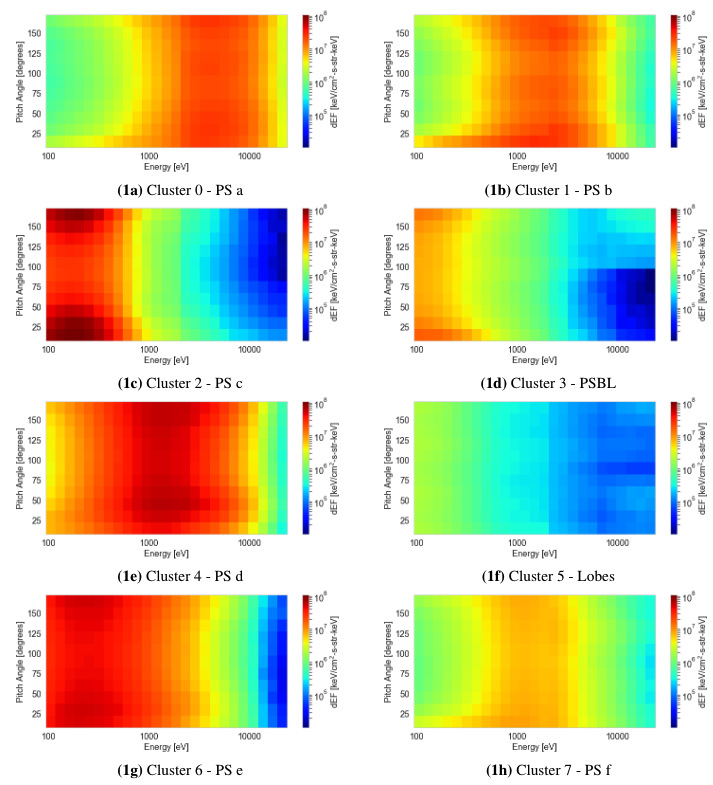
Fig. 1: Average electron differential energy flux distributions as a function of pitch angle and energy for each of the eight clusters (A–H) classified by the agglomerative clustering algorithm. Each cluster is assigned a magnetotail region (included in the sub-captions) based on our interpretation of their plasma and magnetic field parameters.
Please see the paper for full details:
M. R. Bakrania, Rae I. J., Walsh A. P., Verscharen D. and Smith A. W. (2020). Using Dimensionality Reduction and Clustering Techniques to Classify Space Plasma Regimes. Front. Astron. Space Sci. 7:593516. https://doi.org/10.3389/fspas.2020.593516
Polytropic Behavior of Solar Wind Protons Observed by Parker Solar Probe
by Georgios Nicolaou (MSSL, UCL)
The polytropic equation relates the density and temperature of a fluid through the polytropic index. The polytropic index is a crucial parameter in understanding the physical mechanisms acting on the fluid. In this study, we investigate the large time-scale and the short time-scale fluctuations of the plasma proton density and temperature in order to determine their polytropic index. The large time-scale fluctuations which are associated with the plasma expansion within the heliosphere, follow a polytropic model with a polytropic index ~5/3. The specific behavior is consistent with an adiabatic expanding plasma protons with three degrees of freedom. The radial profile of the density follows in general, the model for a spherical expansion with a constant radial speed (see Figure 1). However, the short time-scale fluctuations, which are associated with plasma turbulence, follow a polytropic model with a polytropic index ~2.7. Interestingly, the short time-scale polytropic index is found to be correlated with the interplanetary magnetic field. We discuss the possibly of a mechanism that supplies/retains energy from the plasma protons in these short time-scales, or a mechanism that restricts the effective degrees of freedom of the protons. We finally highlight the importance of future studies that examine the polytropic index along with the characteristics of the full 3D distributions of the plasma ions and electrons.
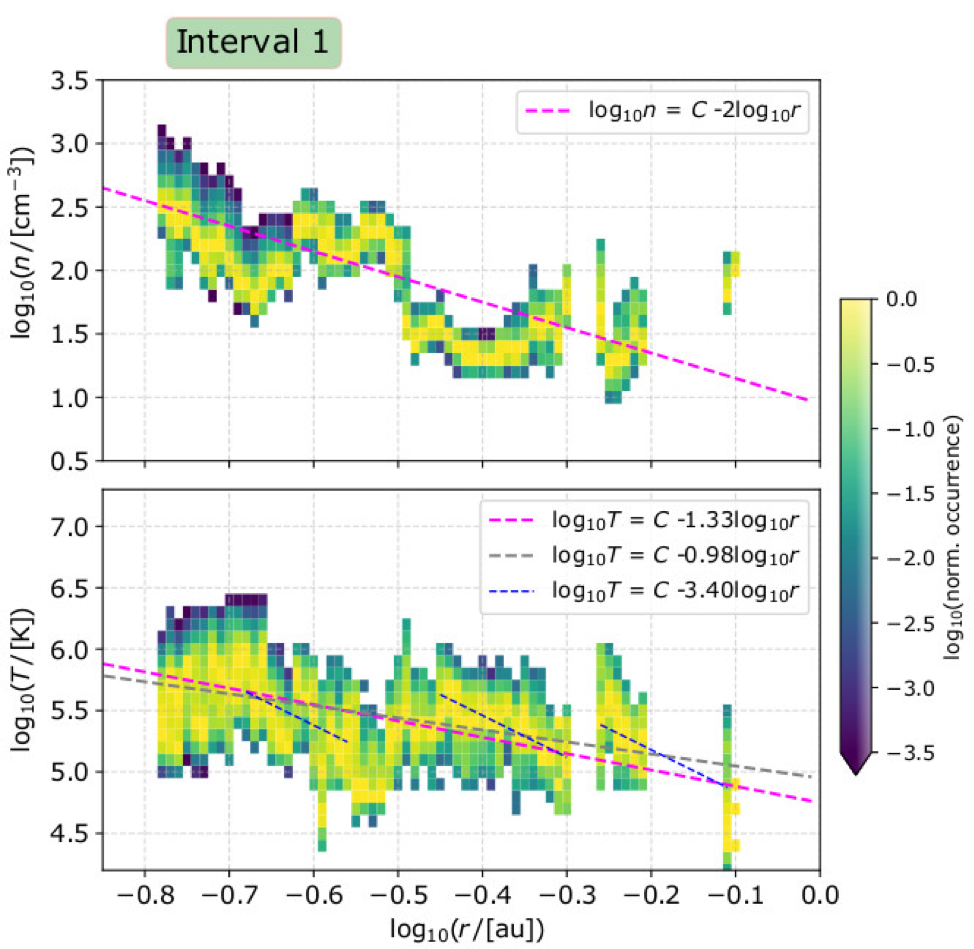
Figure 1. Two-dimensional histograms of (top) the proton density and (bottom) the proton temperature as functions of the radial distance for time interval 1. The magenta line in the top panel shows the expected density for an expansion model with constant speed, n ∝ r-2. In the lower panel, the magenta line shows the expected temperature of a polytropic radial expansion model with γ = 5/3 while the blue lines represent expansion models with γ = 2.7. The grey line illustrates the slope determined by Huang et al. 2020 for the parallel proton temperature of fast solar wind observed by SPC.
Please see the paper for full details:
Nicolaou, G., Livadiotis, G., Wicks, R. T., Verscharen, D., Maruca, B. A., (2020). Polytropic Behavior of Solar Wind Protons Observed by Parker Solar Probe. The Astrophysical Journal, 901, 1, https://doi.org/10.3847/1538-4357/abaaae.
Evaluating the ionospheric mass source for the magnetospheres of Jupiter and Saturn
By Carley J. Martin (Lancaster University)
Ionospheric outflow is a flow of plasma initiated by a loss of equilibrium along a magnetic field line. This induces an electric field due to the separation of electrons and ions in a gravitational field. At Earth, this process is initiated by dayside reconnection in the Dungey cycle. But, is this the case at the gas giants?
Valek+ (2019) show that there is an increased outflow on field lines which map between the moon Io and the auroral oval at Jupiter, and very little in the actual polar cap. Hence, in our analysis, we evaluate over these latitudes at Jupiter and Saturn. This also means we must consider a different driver than the Dungey cycle!
We developed a model which estimates the number of charged particles that flow from the ionospheres of Jupiter and Saturn. We also look at the effects of field aligned currents (FACs) and centrifugal forces on the total source rates of the outflow. At Saturn, the inclusion of these effects increase the total flux from the ionosphere, and it is now comparable to in situ measurements by Cassini CAPS. At Jupiter, the total particle source is found to be comparable to Io as a source of plasma in the magnetosphere. We find that the downward FACs and centrifugal force act to increase the flow of electrons from the ionosphere, and conversely upward FAC’s act to decrease outflow (see Figure below).
The additional mass flux into the inner and middle magnetospheres of Jupiter and Saturn can substantially affect the dynamics and composition and so must be included in any future assessment!
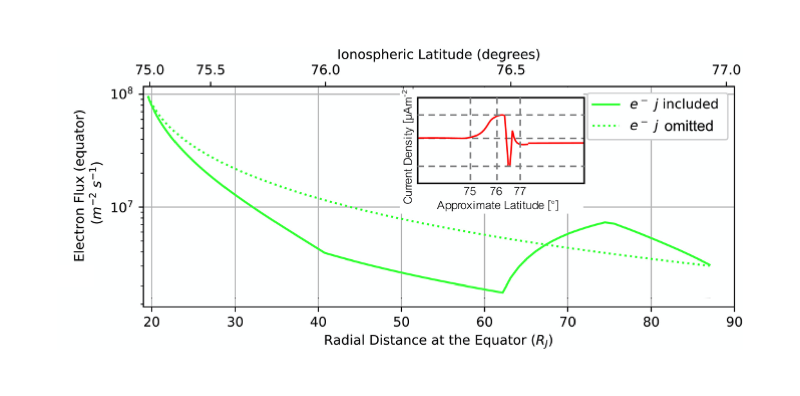
Figure shows an example of results for the electron flux mapped to the equator; solid green is with field‐aligned currents; dotted green is without field‐aligned currents. The insert shows the shape of the field‐aligned currents themselves. The electron flux is highly modified by the field‐aligned currents present, where it is enhanced by a downward current and retarded by an upward current in the auroral regions.
Please see the papers for full details:
, , , , , & , et al. (2020). The effect of field‐aligned currents and centrifugal forces on ionospheric outflow at Saturn. Journal of Geophysical Research: Space Physics, 125, e2019JA027728. https://doi.org/10.1029/2019JA027728
, , , , , & (2020). Evaluating the ionospheric mass source for Jupiter's magnetosphere: An ionospheric outflow model for the auroral regions. Journal of Geophysical Research: Space Physics, 125, e2019JA027727. https://doi.org/10.1029/2019JA027727
Saturn’s Nightside Dynamics During Cassini’s F Ring and Proximal Orbits: Response to Solar Wind and Planetary Period Oscillation Modulations
By Tom J. Bradley (University of Leicester)
In this study we examined the final 44 Cassini spacecraft orbits that traversed the midnight sector of Saturn’s magnetosphere to distances of ~21 Saturn radii, in order to investigate responses to heliospheric conditions inferred from model solar wind and Cassini galactic cosmic ray (GCR) flux data.
Clear responses to anticipated magnetospheric compressions were observed in magnetic field and energetic particle data, together with Saturn kilometric radiation (SKR), auroral hiss, and ultraviolet auroral emissions. Most compression events were associated with corotating interaction regions, as shown by the periodic model solar wind parameters and Forbush-like decreases in GCR fluxes in Figure 1.
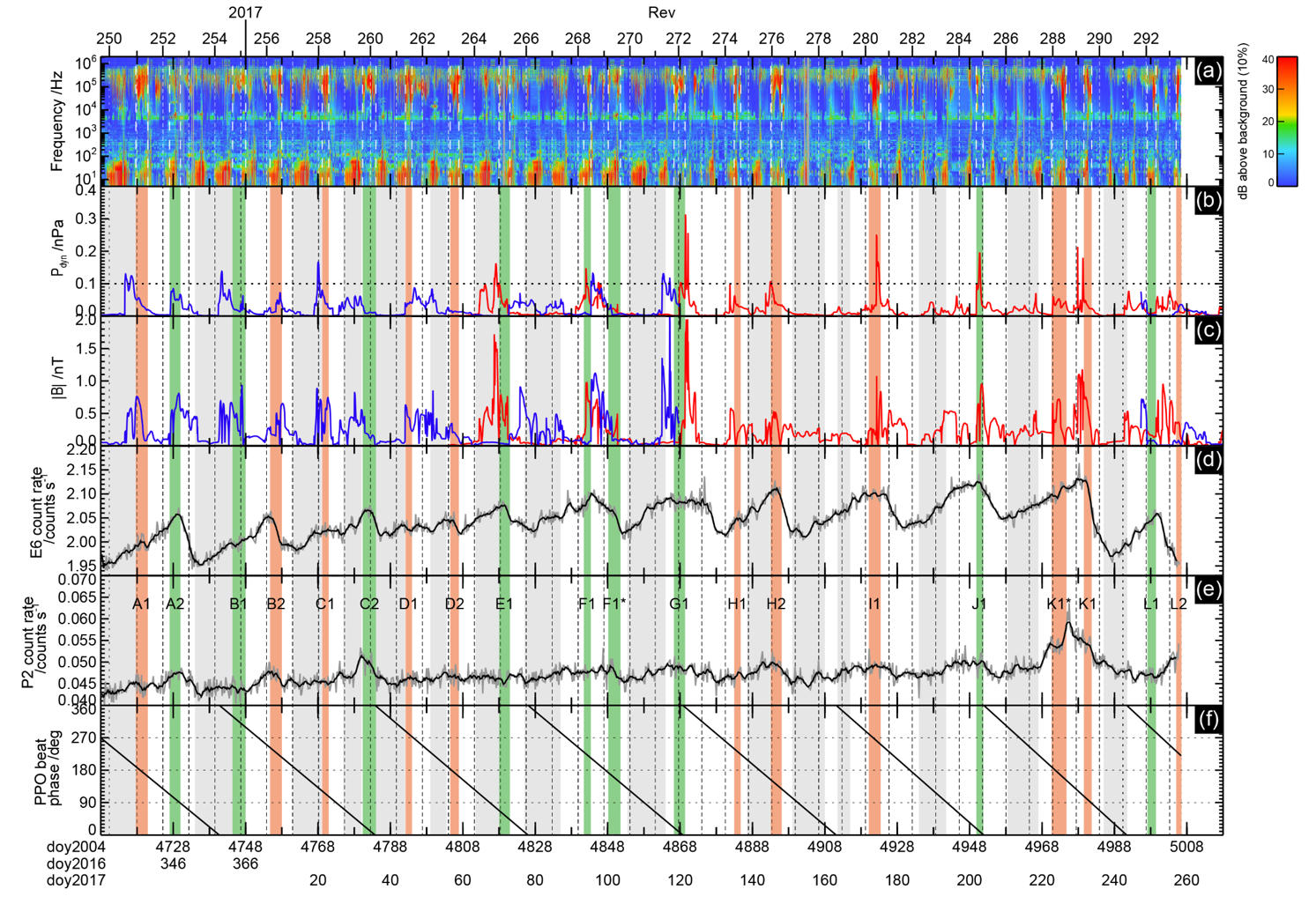
Figure 1: Overview of full dataset. Figure 1a shows a RPWS spectrogram, and Figures 1b-1e show model solar wind dynamic pressure (nPa), IMF strength (nT), LEMMS channel E6 count rate (GCR flux of >120 MeV protons), and LEMMS channel P2 count rate (GCR flux as well as SEP flux of 2.3-4.5 MeV protons). Figure 1f shows the PPO beat phase (deg modulo 360°). The superposed red and green shaded vertical bands (white dashed lines in Figure 1a) show intervals of magnetospheric compression defined by criteria given above. Red corresponds to major events with an extended LFE interval (longer than one planetary rotation) and green to minor events without such an extended LFE interval. The superposed grey shaded vertical bands show intervals of relative magnetospheric quiet when energetic particle fluxes were at near-minimum values.
Each compression tended to produce ~2-3.5 day intervals of magnetospheric activity that were typically recurrent with the ~26 day solar rotation period (one or two such events per rotation). However, the responses were somewhat variable (as is shown in greater detail in the article), and were thus divided into “major” and “minor” events. Major events (red shaded bands) are those with SKR low frequency extension (LFE) intervals with durations greater than ~one planetary rotation (11 out of 20 events, or 55%), while minor events (green shaded bands) either have no noticeable LFE interval (7 out of 20 events, or 35%), or one whose duration is one planetary rotation period or less (2 out of 20 events, or 10%)
These two types of responses were found to be modulated by Saturn’s planetary period oscillations (PPOs), as follows.
- Major events are favoured when the two PPO systems are roughly in anti-phase, where they act together to thin and thicken the tail plasma sheet during each PPO cycle. The anti-phase conditions during major events result in thin plasma sheet conditions (once per rotation), that are most unstable to tail reconnection, producing energetic nightside particle injections and poleward contractions of dawn-brightened auroras.
- Minor events are favoured when the PPOs are in phase, where they act together to stabilise the plasma sheet and inhibit tail collapse, resulting in less obvious magnetospheric responses.
Overall, the results emphasize how strongly activity in Saturn’s magnetosphere is modulated by both the concurrent heliospheric conditions and the PPO modulations.
Please see the paper for full details:
Bradley, T. J., Cowley, S. W. H., Bunce, E. J., Melin, H., Provan, G., & Nichols, J. D., et al. (2020). Saturn's nightside dynamics during Cassini's F ring and proximal orbits: Response to solar wind and planetary period oscillation modulations. Journal of Geophysical Research: Space Physics, 125, e2020JA027907. https://doi.org/10.1029/2020JA027907
The visual complexity of coronal mass ejections follows the solar cycle
By Shannon Jones (University of Reading)
Coronal Mass Ejections (CMEs), or solar storms, are huge eruptions of particles and magnetic field from the Sun. With the help of 4,028 citizen scientists, we found that the appearance of CMEs changes over the solar cycle, with CMEs appearing more visually complex towards solar maximum.
We created a Zooniverse citizen science project in collaboration with the UK Science Museum, where we showed pairs of images of CMEs from the Heliospheric (wide-angle white-light) Imagers on board the twin STEREO spacecraft, and asked participants to decide whether the left or right CME looked most complicated, or complex. We used these data to rank 1,110 CMEs in order of their relative visual complexity. Figure 1 shows three example storms from across the ranking (see figshare for an animation with all CMEs).
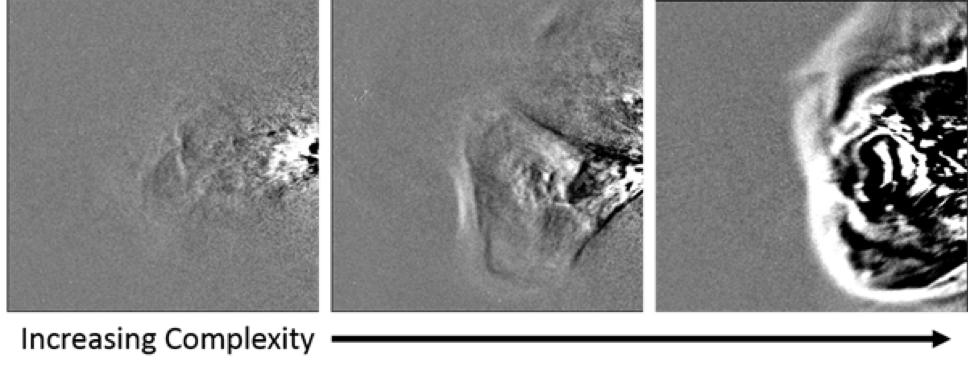
Figure 1. Example images showing three example CMEs in ranked order of subjective complexity increasing from low (left-hand image) through to high (right-hand image).
Figure 2 shows the relative complexity of all 1,110 CMEs, with CMEs observed by STEREO-A shown by pink dots, and CMEs observed by STEREO-B shown by blue dots. This shows that the annual average complexity values follow the solar cycle, and that the average complexity of CMEs observed by STEREO-B is consistently lower that the complexity of CMEs observed by STEREO-A.
These results suggest that there is some predictability in the structure of CMEs, which may help to improve future space weather forecasts.
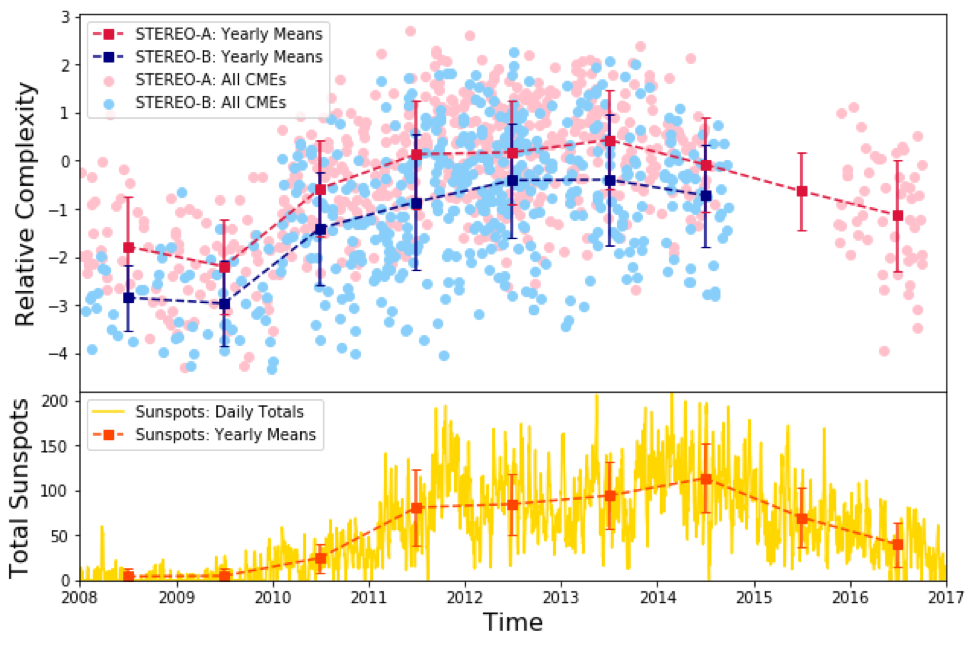
Figure 2. Top panel: relative complexity of every CME in the ranking plotted against time. Pink points represent STEREO-A images, while blue points represent STEREO-B images. Annual means and standard deviations are over plotted for STEREO-A (red dashed line) and STEREO-B (blue dashed line) CMEs. Bottom panel: Daily total sunspot number from SILSO shown in yellow, with annual means over plotted (orange dashed line).
See the paper for more details:
Jones, S. R., C. J. Scott, L. A. Barnard, R. Highfield, C. J. Lintott and E. Baeten (2020): The visual complexity of coronal mass ejections follows the solar cycle. Space Weather, https://doi.org/10.1029/2020SW002556.